Showing posts with label Political Science. Show all posts

Friday, June 12, 2015

6/2: Meeting at COLEF on Environmental Justice

Tuesday two weeks ago, we concluded this 2nd year of IFER with our traditional visit to the Colegio de la Frontera Norte (COLEF) in Tijuana. As usual, the reception at COLEF was very warm, and the talks led to an engaged, interdisciplinary discussion of the topic.

That topic was "environmental justice," and each of the speakers addressed it from their unique perspective. David Carruthers provided a good foundation for the session by explaining what environmental justice is, and then by providing a number of case studies of environmental justice on the Mexican-American border. What I found remarkable about his talk is that his case studies represented victories over big corporations by local people, something that I don't dare to hope for sometimes.

Yazmin Ochoa González then further zoomed in on the place where we were. She proposed three scenarios for a more environmentally responsible TJ. TJ quickly needs to protect its natural resources, not only for the purpose of ecological conservation, but also to protect itself from environmental disasters like flooding. The explosion of the city's urban residents has not been kind to green areas, and Ochoa provided remedies for this problem.

Heber Huizar Contreras went on in a similar vein, presenting an investigation of the access Tijuana residents have to parks, the quality of those parks, and whether this access represents a class division (e.g. the rich having more and better access than the disadvantaged parts of society). He concluded that access in Tijuana is very poor, but it is poor for everyone regardless of class (in the course of the discussion after, Kyle Haines suggested that this might be due to the fact that TJ only recently became a large city. If you'd go to older megacities, he argued you'd find the class division as to access to green areas would exist). In the course of his talk, Huizar questioned established environmental notions, for example the United Nations' definition of a "park" as a "flat space," an model not difficult to realize in more hilly regions like TJ but also leading to misperception of how many "parks" are actually there.

The discussion, as usual, was lively, with a lot of the debate focusing on environmental justice movements in Mexico, and the role of governments (Mexican, American, United Nations) in protecting our ecological heritage. After the discussion was over, many of us enjoyed a wonderful reception at COLEF, followed by a tasty Mexican dinner in downtown Tijuana. All in all, it was a fitting conclusion to a good year.

A video of the whole meeting is available here.

Wednesday, April 29, 2015

IFER Session on "Geo-engineering our Climate"

Last Tuesday, two speakers addressed the problematic of "geo-engineering" from two very different angles. By "geo-engineering," we meant a large problematic that can be summarized as "What to do if the measures against global warming proposed in the past - mainly cutting carbon emissions - cannot be applied in time? How else can we avert the predicted climatological catastrophe?" Apparently this topic has been taken up in some science circles already, and Jack Pan (SIO), our first speaker that evening, gave a witty and clear introduction to some of the issues involved. Some of the measures (like putting mirrors in front of the sun to reflect light back) seem clearly ridiculous, whereas others (putting extra clouds in the sky to shield us) reminded me of a science fiction film where such measures did not turn out to achieve the desire effects (Highlander II: The Quickening).

After Jack's lucid introduction to the issue from a scientific perspective, Kyle Haines (UCSD Political Theory) talked about the ethical and political implications of such technologies. Specifically, Kyle pointed to the fact that if we ever obtain technology that can fundamentally "protect" our climate, we still don't know who gets to decide to use it. If we already have problems curbing carbon emissions globally, then how can we make a global decision to use climate-altering technologies? Worse, it is probably that some of us, namely the global poor, will not be involved in the decision-making process at all! Kyle then explored this argument via a historical parallel: the peaceful use, by both the US and the Soviet Union, of nuclear arms to alter the shape of the environment.

Kyle and Jack's diverging positions on the subject brought about a lively, roundtable debate with the audience. People from widely varying disciplines, such as economics, biology, climate science, and literature (me) brought their perspectives on the issue to the table. Some argued that no global geo-engineering is necessary, and that all measures will be local (for reasons of cost alone). Others talked about a small token government tax on gas that may cause people to rethink using their vehicles too much. The debate took place in a friendly, welcoming atmosphere, which allowed people to really listen to what others had to say, softening the disciplinary boundaries that so often separate our work.

In summary, this was a very successful session, and I can only hope the session the rest of this quarter proceed in a similar manner. Thank you Kyle and Jack for presenting!

Monday, April 13, 2015

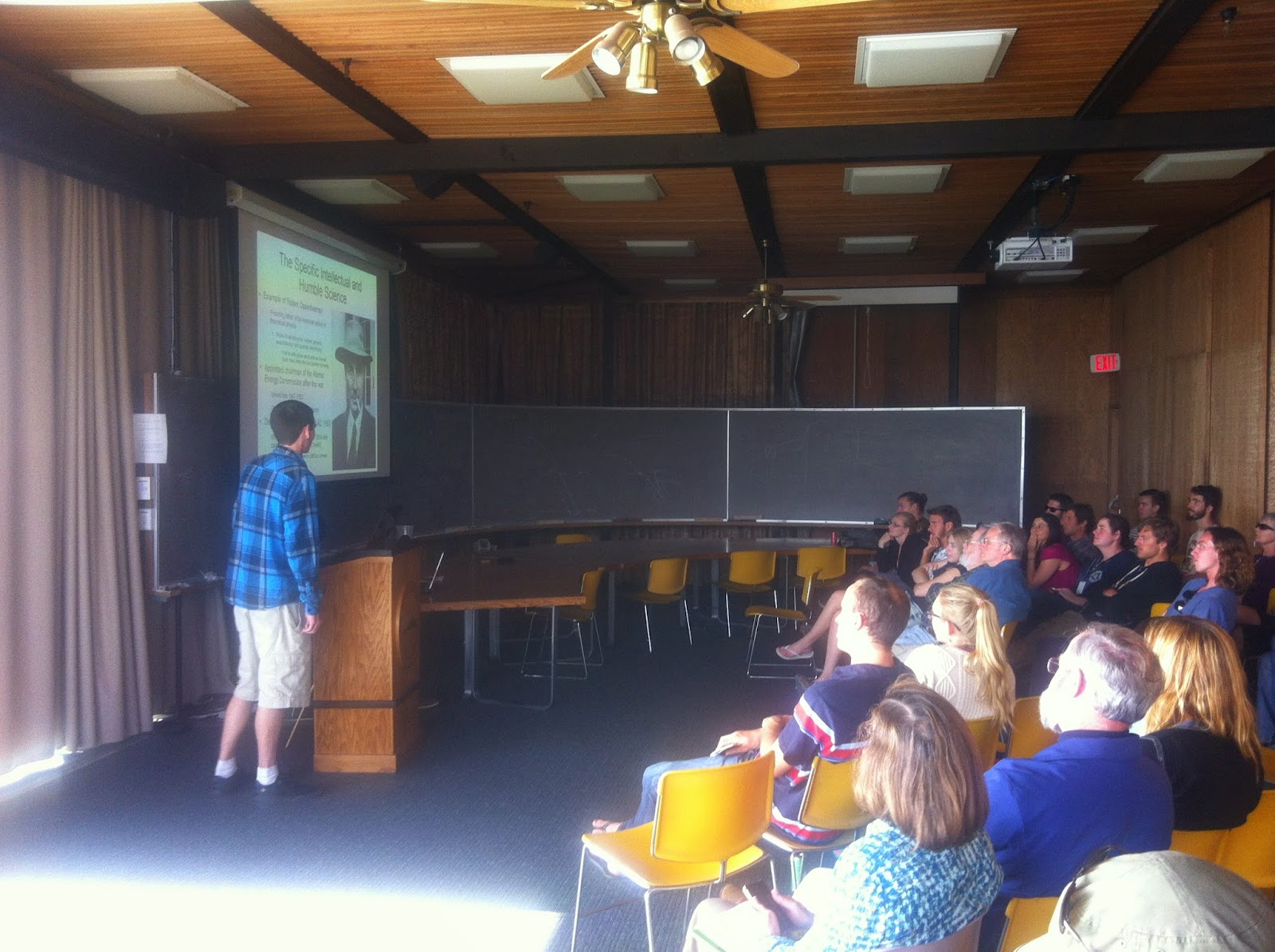
IFER Session on April 6: "Engaging the Everyday: the Challenge for Environmentalism and Political Theory"

Last week, John Meyer, a political science professor at Humboldt State University, came and talked to us about his new book, Engaging the Everyday, which addresses the question: why is there such a lack of political action on environmental change. In his talk, which was thankfully free from jargon so a lay person like me could understand, Meyer first debunked the idea that Americans don't care about environmental change, or think it doesn't exist. An overwhelming majority do think it exists, and do care, but it's simply not the first thing on their list of things to solve. The challenge for American politicians concerned with global warming is thus not to tell people it's important (they already know) but to connect the issue to more urgent "everyday" issues that rank as more important with the American people (issues like wages, employment, safety, etc.).

Meyer's focus on "everyday" concerns allows us to see that any demand for urgent action on climate change needs to be coordinated with equally important changes. People want to eat, want the ability to afford rent and other common expenses without going into debt. Such issues are not separate from those of climate change: indeed, global warming might exacerbate many of them. But an exclusive focus on "global warming" can lead us to forget other political and social problems the resolution of which is at least as urgent as taking action on climate change.