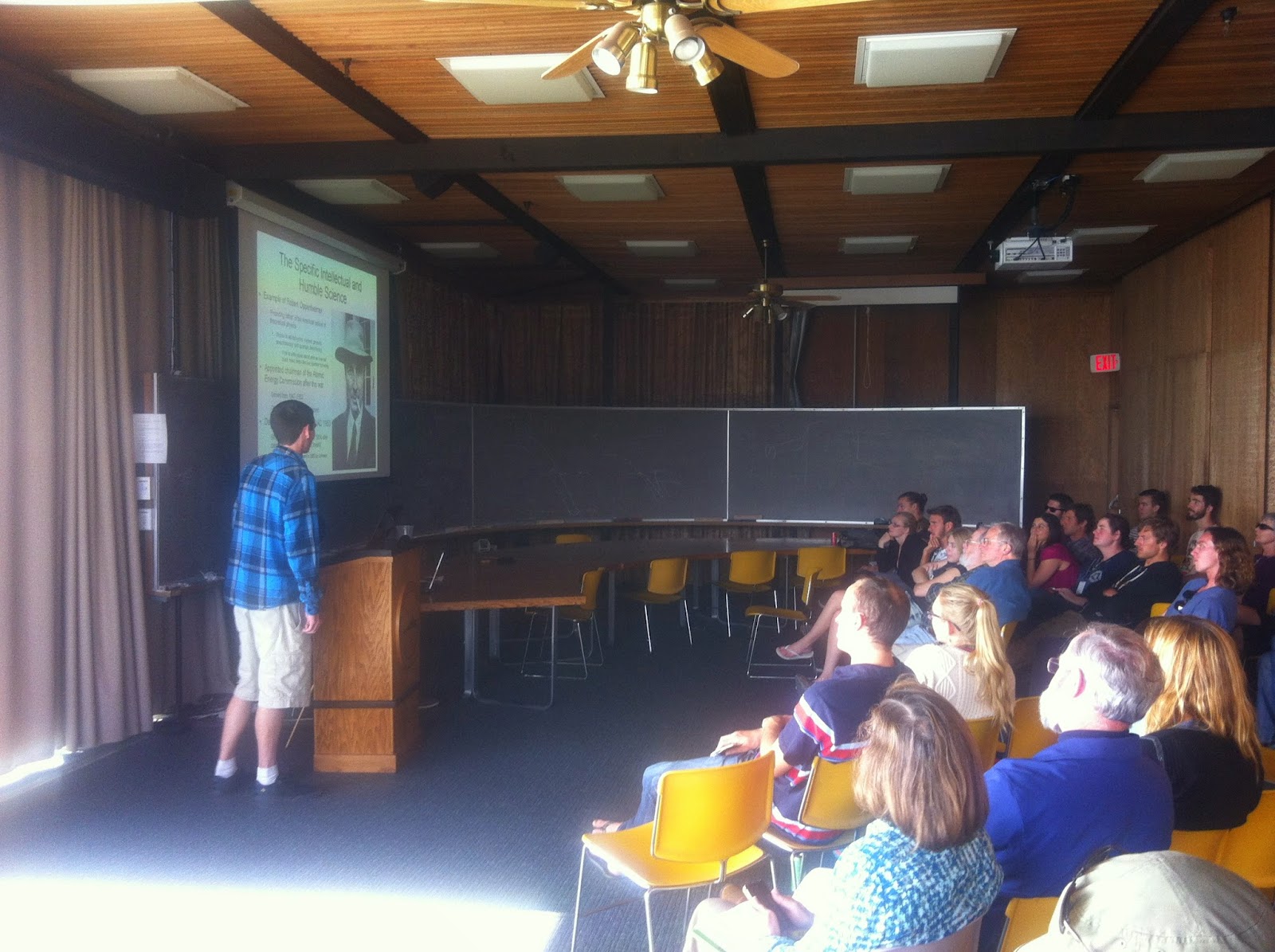
Discussion began fairly quickly and ranged from this specific short story to the genre of "science fiction" in general. It was objected by some that the name "science fiction" is a misnomer, in that such fiction is not necessarily scientific, something shown, I would add, by the "Book of Martha," which by its Biblical setting reminds one more of fantasy than SciFi. The relation between Fantasy and SciFi was also questioned by Ike, who told us that some authors, like the amazing Ursula LeGuin, prefer the term "speculative fiction" to talk about their work, rather than the standardized "science fiction" and "fantasy."
Another question that occupied us was the matter of utopia and dystopia. What purposes do such fictions, portraying ideal or non-ideal futures, serve? Does it make a difference, for example, when we see a vision so dark as that proposed by the second episode of the BBC series Black Mirror (one that I highly recommend you watch)? Does it make us get off our couch to cure the many symptoms of a burgeoning bleak disease that the dystopic mirror has shown us? Or does the fiction merely remain such, something to entertain us through a boring night when we cannot sleep? Although none of the participants had answers to such questions, talking about them within our multidisciplinary, binational frame was very interesting. I say "binational" because our colleagues from COLEF were present again in great numbers. We thank you for crossing the border to join us, again and again, and for adding your voices to the debate.
The matter of "science" fiction came up again in a different context: in "The Book of Martha," the short story Ethan read for us, the main character, a black female writer called Martha, can change humanity for the better. She just needs to tell God (hence the title: "Book of Martha," as if this was a book in some new bible) how she wants to change humans, and it will happen. After careful deliberation, her solution is to give humans very vivid dreams that would make us less greedy and violent in actual reality because anything we want we would get in these dreams. Martha's solution was heavily contested by the group. Alternative solutions ranged from the purely technological ("giving people cat eyes so they can see in the dark") to the idealistic ("making humans more social and less egocentric"). What struck me was that in doing these things, we were actually writing a science fiction of what science might be able to do in the future. If we had the capacity to choose whether humans can have cat eyes or not, would we? What about making all of us more social through surgery? The debate thus somewhat eerily echoed the one we had during the geo-engineering session, the question of which boils down to: "what are we, humans, allowed to do to our environment? Can we intervene at all?"
Again, there's no definitive answer to these questions, but IFER meetings have allowed us to deepen our knowledge on such debates. Next Tuesday afternoon
, we will go to the other side of the border to explore the theme of environmental justice. We hope you'll join us in Tijuana!